Most people handle coins every day without giving them a second thought. Yet every so often, an ordinary-looking piece of pocket change turns out to be worth more than a car payment — sometimes more than a month’s rent. The 1976 quarter is one of those coins many Americans have seen countless times, but few realize that certain high-grade versions of the no-mint-mark bicentennial quarter can be worth up to $4,500.
If you’ve ever wondered whether one of your spare-change treasures might be a sleeper hit in the coin market, this deep dive will show you exactly what to look for, how the value is determined, and how to get yours authenticated.
Why a Common 25-Cent Coin Can Command Thousands
Most U.S. coins are mass-produced, which leads many people to assume none of them could be valuable. But collectors obsess over scarcity in high grades, and modern coins — even from the 1970s — rarely survive in pristine condition. A lucky combination of low population, preserved luster, and collector demand can catapult a coin from pocket change to investment-grade collectible.
The three variables that control modern coin prices
1. Rarity and population reports
The total number of coins minted tells part of the story, but what collectors care about most is how many examples still exist in exceptional condition. Third-party grading agencies publish “population reports” showing how many coins have been certified at each grade level. When only a handful reach the top — such as MS68 for a 1976 quarter — prices can soar.
2. Condition, grading scales, and market premiums
Professional graders assign a numerical score from 1 to 70. Coins graded MS65+ are considered gem-quality, while MS68 is almost flawless. For modern circulation strikes, that difference can mean thousands of dollars in value. Tiny contact marks, slight discoloration, or faint scratches can drop a coin by multiple grades.
3. Collector demand and financial momentum
Popular themes — like the American Bicentennial — attract both enthusiasts and investors. When demand rises faster than available supply, prices adjust upward. The 1976 quarter benefits from nostalgia, patriotic energy, and widespread recognition, making it one of the most sought-after modern commemorative issues.
Why the U.S. Mint redesigned quarters for one year only
To honor the 200th anniversary of the signing of the Declaration of Independence, the U.S. Mint authorized special reverse designs for quarters, half dollars, and dollars in 1976. This makes the bicentennial quarter visually distinctive from all Washington quarters minted before or after.
What makes the bicentennial series different
Obverse design elements collectors expect
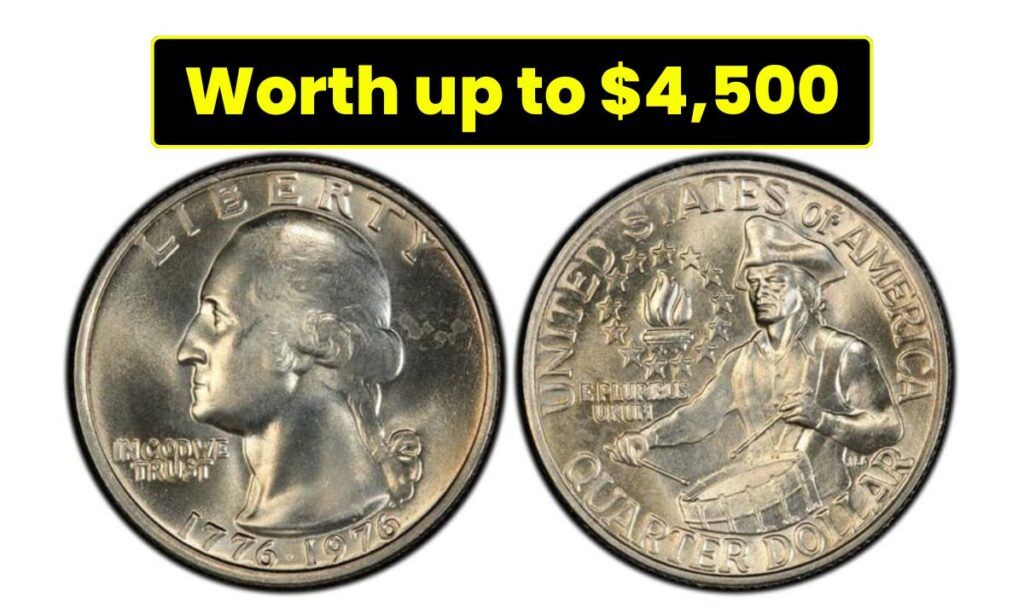
The obverse still displays the traditional bust of George Washington, but instead of a single year, it carries the dual date “1776–1976”, unique to this commemorative issue.
Reverse artwork and symbolism
The reverse, designed by Jack L. Ahr, features:
- A colonial drummer facing left
- A torch of victory
- Thirteen stars, symbolizing the original colonies
- The inscriptions UNITED STATES OF AMERICA, E PLURIBUS UNUM, and QUARTER DOLLAR
These design elements are widely recognized and contribute to the coin’s enduring popularity in the hobby.
The No-Mint-Mark 1976 Quarter: What Sets It Apart
How to locate — or confirm the absence of — a mint mark
Mint marks appear on the obverse, usually near Washington’s portrait. For 1976 quarters:
- D = Denver
- S = San Francisco
- No mark = Philadelphia
The valuable coin in question is the Philadelphia no-mint-mark bicentennial quarter — but only in extremely high grades.
Why Philadelphia-minted pieces can be unique in high grade
Philadelphia minted hundreds of millions of these coins, but the vast majority entered circulation immediately. Very few were preserved intentionally. That means only a tiny fraction remain in near-perfect condition today.
The misconception around the “error coin” label
Why it’s not actually an error
A no-mint-mark 1976 quarter is not a mint error. Prior to 1980, the Philadelphia Mint simply didn’t use a mint mark on quarters. The value comes not from the lack of a letter but from the extreme scarcity of top-tier MS67 and MS68 examples.
How Much Is a 1976 No-Mint-Mark Quarter Worth Today?
Price ranges from circulated to top-tier mint state
Here’s a general market overview:
- Circulated condition (the kind found in pocket change): $0.25 to $1
- Mint State (MS60–MS64): $10 to $30
- MS65: $40 to $85
- MS66: $150 to $300
- MS67: $600 to $1,200
- MS68: $3,000 to $4,500+
Collectors pay steep premiums for coins at the highest available grade.
Why MS68 examples are extremely scarce
To reach MS68, a coin must be virtually flawless under magnification. That means:
- No noticeable contact marks
- No discoloration
- Strong luster
- Crisp strike
- Full original details
Few mass-produced coins survive that cleanly.
Market sales data and collector behavior
Auction records show that only a handful of MS68 no-mint-mark bicentennial quarters sell each year, and when they do, competition is strong. Prices remain stable even during economic downturns because modern U.S. coinage attracts both specialists and casual hobbyists.
How grading agencies influence real-world pricing
PCGS and NGC are the two most trusted grading companies. A coin graded MS68 by either has solid market credibility. Coins graded by lesser-known services often sell at discounts or require regrading.
How to Check Your Own 1976 Quarter
Step-by-step quick inspection checklist
- Check the date: It must read 1776–1976.
- Look for the mint mark: No D or S should appear.
- Examine the surfaces under good lighting: Minimal scratches, high luster, and a clean reverse drummer are good signs.
- Inspect the edges: Damage or heavy wear lowers value significantly.
- Use a 5x–10x magnifier: Many small imperfections aren’t visible to the naked eye.
Signs of damage that disqualify a coin from higher value
- Deep scratches
- Environmental tarnish
- Rim dings
- Cleaning marks (cleaned coins lose most of their value)
- Heavy circulation wear
When to submit your coin for professional grading
Grading is worthwhile if:
- Your coin appears well above average
- It shows no visible damage
- It looks sharper than typical pocket-change bicentennial quarters
If it seems pristine or nearly so, certification could substantially increase its resale value.
Trusted platforms to compare pricing
Collectors often validate their findings using:
- Professional Coin Grading Service (PCGS) price guide
- Numismatic Guaranty Company (NGC) price guide
- Heritage Auctions past sales
- eBay sold listings (not asking prices)
Where to Sell a Valuable Quarter Safely
Pawn shops vs. reputable coin dealers
Pawn shops may offer fast cash but often lowball customers. A professional coin dealer or numismatic shop can give a more accurate valuation based on true market demand.
Auction houses, online marketplaces, and private collectors
High-grade graded coins typically bring the best results at auction. Online marketplaces like eBay work well for mid-grade examples, but high-value coins should go through established numismatic auctions where collectors compete.
Protecting yourself from undervaluation or scams
- Always compare multiple offers.
- Avoid selling valuable coins ungraded.
- Use platforms with seller protections and transparent feedback systems.
- Store the coin in a protective holder during the selling process.
Q : Are all 1976 quarters valuable?
Ans : No. Most 1976 quarters in circulation are worth face value. Only high-grade no-mint-mark coins certified MS67 or MS68 command hundreds or thousands of dollars.
Q : How rare is a 1976 quarter with no mint mark?
Ans : The no-mint-mark version is common overall, but rare in top grades. That scarcity — not the mint mark itself — creates the high value.
Q : What makes an MS68 grade so difficult to achieve?
Ans : MS68 coins must be nearly flawless even under magnification. Small contact marks, mild discoloration, or slight handling can prevent a coin from reaching that level.
Q : Can circulated bicentennial quarters still be worth money?
Ans : Circulated coins are generally worth 25 cents, though mildly uncirculated examples may bring a small premium. The four-figure values apply only to top-grade certified coins.
Q : Where should I get my coin professionally graded?
Ans : PCGS and NGC are the most respected grading agencies. Coins graded by these services command the strongest market prices.
Q : Is it possible to find one of these quarters in pocket change today?
Ans : It’s unlikely but not impossible. Millions remain in circulation, though most have moderate wear. High-grade examples are typically found in old collections or bank-wrapped rolls.
Q : How do I store valuable coins to prevent damage?
Ans : Use archival-safe holders, avoid PVC plastic, keep coins away from humidity, and never clean them. Proper storage preserves value.