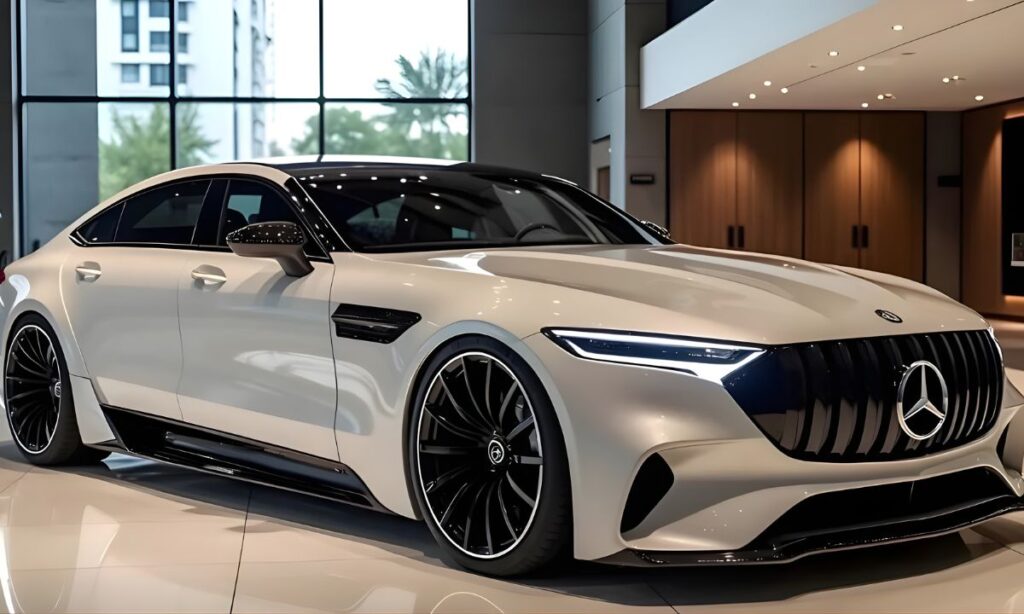
Mercedes-Benz E-Class 2025: The 2025 E-Class isn’t a superficial facelift. Mercedes has tightened a complex brief: keep the E-Class familiar and composed for traditional executive buyers, while quietly folding in electrification, stronger driver aids, and a smarter digital cabin. That makes the 2025 model both a safer daily car and — for buyers in higher trims — a technical showcase: faster acceleration, plug-in electric range that meaningfully reduces town fuel use, and an in-car software stack that starts to blur the line between phone and dashboard. The consequences are practical: lower running cost for PHEV users in urban use, more capable driver aids on highways, and higher residuals for well-specified cars.
Quick snapshot: specs, trims, and who each one suits
Powertrain line-up (I4, I6 mild-hybrid, AMG hybrid)
Mercedes simplified the lineup around three usable cores: a 2.0-litre turbo four for mainstream buyers, a 3.0-litre inline-six with a mild-hybrid system for buyers who want silky power and efficiency, and performance AMGs that now use more electrification — notably an AMG E53 plug-in hybrid that delivers high combined power figures while offering an EV-first mode for city drives. These options let buyers pick from efficient commuting to genuine sporting pace without jumping to a full-EV S-Class alternative.
Key dimensions and variants (LWB market note)
Mercedes continues to offer a long-wheelbase (LWB) E-Class in markets like India, where rear-seat space matters. For many corporate buyers the LWB is the deciding factor; it keeps E-Class competitive against local executive sedans without pushing shoppers into the S-Class.
Price bands and target buyers
Expect mainstream E-Class sedans to start in a luxury-entry price band (US MSRP mid-$60k range for base trims), while higher-spec mild-hybrid and AMG PHEV models climb significantly. In markets like India, fully imported and locally assembled variants push pricing into premium executive territory; select options (driver assistance packs, Burmester audio, Nappa leather) have an outsized impact on final cost.
Interior and tech: practical improvements you’ll notice every day
MBUX, displays, and usability (real-world critique)
MBUX remains the E-Class’s beating heart. The 2025 cabin centers two large digital surfaces: a driver cluster and a sizable touchscreen. Mercedes refined voice recognition and context suggestions so the system anticipates common tasks (climate, navigation to home/work). That’s good, but in real life screen size and graphics can’t replace interface flow: the best in this class keeps frequently used controls reachable without deep menu dives. Mercedes has improved signal latency and responsiveness compared to early MBUX versions, but physical shortcut buttons remain critical for safe, one-touch operation.
Sound, materials and ergonomics (what’s premium vs cosmetic)
Mercedes’s material choices remain a defining differentiator: tight seams, soft-touch instruments, and optional Nappa leather plus configurable ambient lighting make the cabin feel coherent rather than stagey. The available Burmester audio (and front-bass architecture) gives obvious gains in bass and clarity, but evaluate rear-seat comfort and cushion support if you regularly chauffeur passengers — that’s where LWB models demonstrate their value.
Driving dynamics and powertrains: the balance of comfort and sport
How mild-hybrid changes throttle and fuel use
The inline-six mild-hybrid is more than marketing: the B-class 48-volt assist smooths low-end torque delivery, allows coast-stop restart refinement, and trims fuel use in urban cycles. Owners will see the most benefit in stop-start, urban commuting, and during short highway stints where the hybrid assist reduces demands on the turbocharger. The system does not replace plug-in charging but narrows the gap on efficiency and feels more refined than an old-school turbo-only setup.
AMG E53 plug-in hybrid — performance numbers and trade-offs
The AMG E53 for 2025 embraces electrification with serious intent: boosted combined output and a usable all-electric range. That performance comes with weight and packaging trade-offs — the battery and hybrid components lift curb weight and compress trunk space compared with non-hybrid models. If your priority is weekend track pace and quick sprints, the E53 PHEV delivers strong numbers; if you prioritize pure handling lightness and boot space, the conventional AMG-tuned petrol variants (where available) remain attractive.
AWD, suspension modes and real-world ride control
Expect selectable drive modes (Comfort, Sport, Individual, Eco) and variable damping that tune both control and ride comfort. For executives, this means an E-Class that smooths poor city surfaces yet firms up responsively for confident highway transitions — a competency that separates competent luxury sedans from truly refined ones.
Safety and driver assistance: what’s automated, what’s driver responsibility
PRE-SAFE and active safety systems (limits and strengths)
Mercedes still leads with PRE-SAFE occupant preconditioning, which can adjust seat position, tension seatbelts, and raise windows if an imminent collision is detected. The 2025 E-Class layers standard AEB (automated emergency braking), pedestrian detection, and lane-keeping assist with optional adaptive cruise that can center the car in lanes. These systems improve safety margins but are not a substitute for attentive driving — particularly in complex urban scenes where sensor occlusion and edge-case scenarios persist.
ADAS features that improve daily commuting vs long trips
For commuting, lane-centering plus adaptive cruise reduces driver workload on long corridors. On busy city streets, advanced cross-traffic alerts and automated parking assist are genuinely useful. Buyers should opt for the active-safety pack if their route mix includes dense urban driving or lengthy highway commutes; the incremental price can pay back in stress reduction and insurance benefits.
Ownership reality: running costs, practicality, and resale signals
Fuel economy expectations and charging for PHEVs
The PHEV variants can cut city fuel use substantially if daily charging is routine; Edmunds and others report double-digit electric-only miles in real-world urban cycles for higher-capacity PHEV setups, which translates to significant operational savings for short commutes. However, without regular charging the hybrid system acts like added deadweight and fuel economy can degrade versus efficient I4 variants. Plan charging access or choose mild-hybrid versions if you lack reliable home charging.
Aftercare, warranty and service footprint (market nuances)
Service experience is brand-dependent: Mercedes has strong dealer networks in primary markets and localized assembly in places like India supports competitive parts and service lead times. Warranty packages vary regionally; check whether extended maintenance plans and scheduled servicing are included for the first few years — those packages often present better cost certainty than pay-as-you-go servicing for luxury cars.
Final assessment: who should buy the 2025 E-Class — and what to negotiate
Buy a 2025 E-Class if you want a composed executive sedan that blends modern digital comfort with traditional Mercedes refinement. Opt for:
- The I4 if you prioritize cost and efficiency without sacrificing brand cachet.
- The I6 mild-hybrid if you value smoother power delivery and slightly better fuel economy.
- The E53 PHEV if you want near-EV urban operation plus high performance on demand — and you can accept higher purchase and service costs.
Negotiation levers: ask for driver-aid packs, wheel/tyre protection, and service bundles; those options often carry high dealer margins and deliver measurable ownership value.
Competitors to test-drive: BMW 5-Series (sportier steering), Audi A6 (minimalist cabin and fast infotainment), Lexus ES (reliability and value-oriented luxury). Each has a slightly different temperament — the E-Class keeps its lead in cabin refinement and executive presence.
FAQs (schema-optimized — concise answers a searcher expects)
Q : What engines are available in the 2025 Mercedes-Benz E-Class?
Ans : The 2025 E-Class offers a 2.0-litre turbocharged inline-4 as the base engine, a 3.0-litre inline-6 with a 48-volt mild-hybrid system for smoother torque delivery, and electrified AMG variants (including a plug-in hybrid E53) for high performance.
Q : How far can the E-Class PHEV drive on electric power alone?
Ans : Higher-spec E-Class plug-in hybrids report an electric range suitable for typical urban commutes (real-world numbers vary with trim and driving style), often in the tens of miles per charge — sufficient to make daily city driving predominantly electric if you charge frequently.
Q : What new infotainment or tech does the 2025 E-Class add?
Ans : The 2025 E-Class continues with Mercedes’s MBUX system—refined voice control, large integrated displays, and improved context awareness—plus optional audio and comfort packages such as Burmester sound and advanced navigation features.
Q : Is the 2025 E-Class safe for highway driving with ADAS engaged?
Ans : ADAS improves safety and reduces workload on highways (adaptive cruise with lane-centering, AEB). However, drivers must remain attentive — current systems are Level-2 assistance and require human supervision.
Q : How much does the 2025 E-Class cost?
Ans : Prices vary by market and trim. In the U.S., base E-Class pricing starts in the luxury midsize band (MSRP around the mid-$60k range for entry trims), while in markets like India the E-Class sits at a higher executive price point influenced by local specs and LWB options. Always check local dealer quotes and option pack pricing.
Q : Should I choose the LWB E-Class in markets where it’s available?
Ans : hoose LWB if rear-seat space and passenger comfort are priorities (chauffeured use, corporate buyers). If driving yourself mostly, standard wheelbase models offer nearly identical driving dynamics and better maneuverability.
Closing—practical buying checklist for test drives
- Test the I4 and I6 back-to-back to feel throttle response and NVH; evaluate city restart smoothness.
- Try ADAS on a highway; verify lane-centering comfort, camera blind-spot behavior, and automatic braking feel.
- Check boot space with the PHEV spec — batteries can impact luggage volume.
- Confirm service packages and ask for a quoted 3-year total cost of ownership.
- Negotiate