Honda City 2025 Launched: The Honda City for 2025 is an evolution that tightens the sedan’s strengths: refined packaging, incremental exterior and interior updates, and a clearer split between the conventional 1.5-litre i-VTEC petrol range and Honda’s e:HEV hybrid offering. Mechanically it remains close to the proven City recipe — which keeps development risk low — while Honda focuses on perceived value: efficiency, cabin refinement, and updated styling to stay competitive in a crowded C-segment. The official Honda India pages list the 1.5L petrol and the e:HEV specs, confirming the continued emphasis on fuel efficiency and packaging.
Design & cabin — visible evolution, not revolution
Exterior: cleaner lines, sharper face
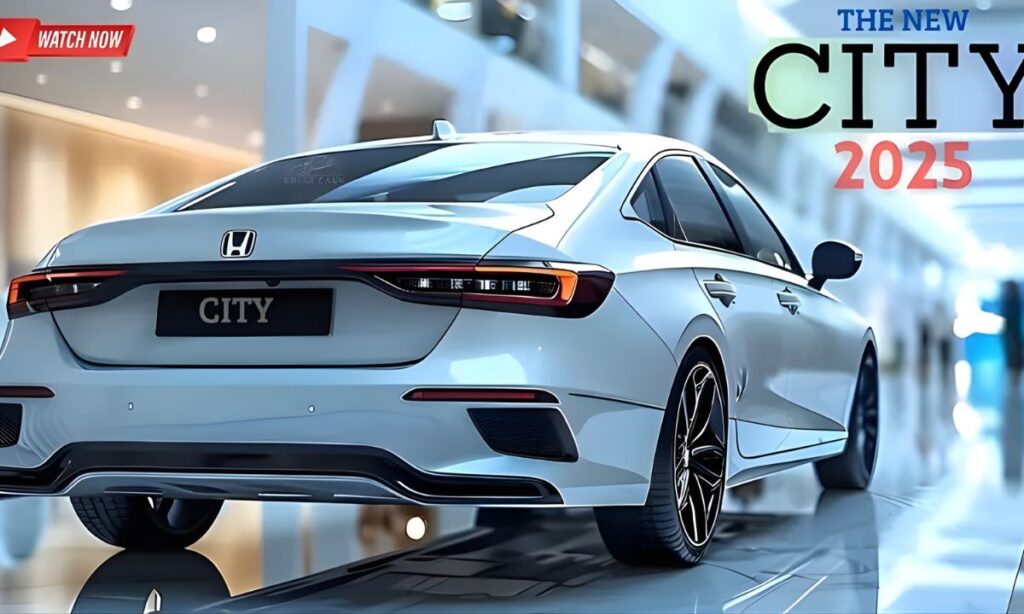
The 2025 update tightens the City’s visual language: slimmer LED headlamps, a more sculpted bumper and a slightly lowered bonnet line that gives the sedan a wider stance on the road. These changes are primarily aesthetic — there are no reported mechanical overhauls — but they matter in two ways: first impressions at showroom level, and a perception of contemporaneity that extends resale value. Sources covering the reveal note the changes are cosmetic and market-timed (Brazil debut, India expected thereafter).
Interior: material upgrades where it counts
Honda has focused cabin updates where owners notice daily: better seat fabrics/leather combinations on higher trims, subtle dashboard re-trim, and an improved infotainment bezel. The City’s packaging still prioritizes rear legroom and a 506-litre boot — a major selling point in the segment — so updates aim to lift perceived quality without compromising space. Detailed spec pages confirm the generous boot and the cabin packaging specs that remain a City strength.
Powertrain choices: predictable, efficient, and segment-relevant
1.5L i-VTEC petrol — proven, efficient
The standard petrol is the long-standing 1,498 cc i-VTEC unit producing roughly 119–121 PS and around 145 Nm of torque, paired to either a 6-speed manual or CVT, with official ARAI mileage figures in the high teens (~18.4 km/l on CVT in standard testing). Those numbers are conservative real-world baselines; expect slightly lower in mixed urban driving. Honda India lists these exact engine and mileage figures on its model page.
e:HEV hybrid — where it makes the difference
The City e:HEV variant is the headline for efficiency-minded buyers: combined system power around 126 PS and an ARAI-claimed combined figure exceeding 27 km/l on the hybrid model — a meaningful jump for buyers who prioritize mileage and city drivability. The hybrid’s advantage shows in stop-start traffic, city consumption and regenerative braking, though purchase price and servicing considerations must be weighed. Honda’s product page lists the e:HEV figures and positioning.
Handling, ride and NVH — what owners will feel daily
Suspension tuning and ride comfort
Honda continues the City’s traditional bias: composed high-speed stability with a compliant low-speed ride. The tuning philosophy remains family-friendly rather than sporty; expect light steering feel at low speeds and confident stability on highways. This is consistent with how Honda has positioned the model historically and reinforced in recent road tests.
Noise, vibration & harshness (NVH)
Refinement has been nudged upward: thicker door seals, revised engine mounts on higher trims, and foam padding in key NVH paths. Hybrid variants also feel quieter during city cruising because the petrol engine cycles off frequently. These are the kinds of marginal gains that translate into perceived quality over time — not flashy headlines, but meaningful comfort gains for daily commuters. (See model spec and hybrid descriptions for confirmation.)
Safety & ADAS — realistic safety, avoid overclaiming
Standard safety kit
The City’s safety baseline includes dual front airbags, ISOFIX, ABS with EBD and a well-engineered body structure that meets current regulatory requirements. Higher trims add side and curtain airbags and more advanced passive safety hardware. For buyers, confirm variant-specific equipment at the dealership; standard safety equipment varies by market and trim.
Assisted driving features: helpful, not hands-off
Honda’s ADAS package (where offered) includes lane-keeping assist, adaptive cruise control and collision mitigation braking. These driver aids are useful for long highway stretches and congested roads but remain driver-assist — not autonomous driving. Treat ADAS as a convenience and safety net rather than a substitute for attention. Independent reviews and official specs outline the feature list and typical limitations
Ownership economics — price moves, fuel, and service
Recent price adjustments and real-world impact
Honda implemented price reductions in 2025 tied to GST changes, passing savings to buyers: some City variants saw reductions up to the ₹40–60k range (and broader HCIL price adjustments of up to ₹1.2 lakh across some models after tax reform). That lowers entry cost and narrows gaps with strong rivals, making the City more compelling for value-focused buyers. News coverage and company announcements document these changes.
Running costs: fuel economy and servicing
Expect the 1.5L petrol to return mid-teens km/l in mixed driving (real world), while e:HEV owners can see city economy in the mid-20s depending on use pattern. Typical 5-year service costs for the City are moderate for the segment; CarDekho and CarWale compile routine service cost estimates that put the City in the mid-range among compact sedans. Factor in battery-supporting maintenance for the hybrid when comparing TCO
Competitive context & buyer profiles
How City stacks up vs rivals
The City’s three core strengths are: rear-seat space, boot capacity and Honda’s long-term reputation for durability. Against rivals (compact sedans and compact SUVs), the City trades a slightly less aggressive exterior for better interior room and better hybrid availability in some markets — a differentiator if fuel economy matters. Sources reporting specs and comparisons confirm that the City remains a segment benchmark for packaging.
Who should buy the 2025 City? (two quick profiles)
- The commuter couple: prioritizes rear legroom, boot space for weekend bags, and low running costs — choose the hybrid if most driving is urban.
- The value-conscious family: wants predictable maintenance, good resale and a comfortable cabin — the petrol CVT or manual base offers the best initial price/resale tradeoff.
FAQ’s Honda City 2025 Launched
Q : What is the fuel efficiency of Honda City 2025 petrol and hybrid?
Ans : The 1.5L petrol CVT has an ARAI figure around 18.4 km/l; the City e:HEV hybrid claims roughly 27.26 km/l (combined). Real-world numbers vary by driving style and traffic.
Q : What are the engine specifications of the 2025 Honda City?
Ans : Petrol: 1,498 cc i-VTEC, ~119–121 PS and ~145 Nm, with 6-speed manual or CVT options. Hybrid: combined system output around 126 PS. Confirm variant specs on Honda’s official page
Q : Has Honda changed the City’s price in 2025?
Ans : Yes — Honda adjusted prices following the GST reform and announced cuts across several models; specific City variants saw reductions in the ₹40k–₹60k band, with broader HCIL adjustments in related models. Check local ex-showroom quotes for exact figures.
Q : Is the City e:HEV worth the premium?
Ans : If most driving is urban and you prioritize fuel economy and quieter city operation, the hybrid’s higher upfront cost can be justified by lower running costs and better city efficiency. For mostly highway miles, the standard petrol CVT is still efficient and typically cheaper to buy.
Q : What is the boot space and passenger room like in the 2025 City?
Ans : The City continues to offer a class-leading boot (~506 litres) and exceptional rear legroom — strong selling points compared with many compact SUVs and rivals.