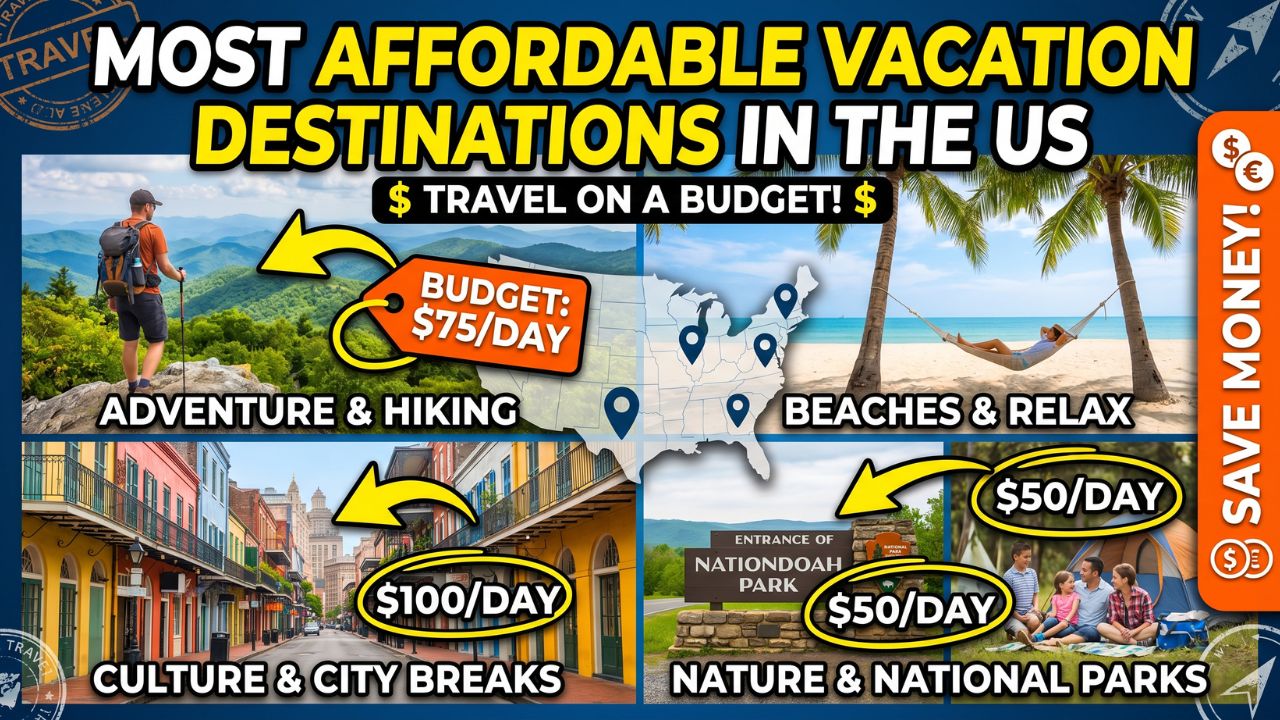
Most Affordable Vacation Destinations in the US – You know that feeling — it’s mid-January, you’re staring out a frost-covered window, and every cell in your body is screaming for a beach, a mountain trail, or a plate of something delicious you didn’t have to cook yourself. But then the mental math kicks in. Flights. Hotel. Food. Activities. And just like that, your dream trip quietly dissolves back into a Pinterest board.
Here’s what most travel sites won’t tell you: some of the best trips of your life are hiding in your own backyard, and they cost a fraction of what you’d drop on a week in Cancún or a long weekend in New York City. The most affordable vacation destinations in the US aren’t the consolation prizes of travel — they’re the best-kept secrets of the people who travel the most.
I’ve spent years crisscrossing this country on shoestring budgets, chasing sunsets in places that barely made the listicles. And what I found consistently surprised me. Great food. Gorgeous scenery. Genuinely friendly people. And a nightly hotel rate that didn’t require a financial recovery plan afterward.




Let me take you through the places that actually delivered — and save you the trial-and-error I went through to find them.
Quick Facts: Planning Your Budget US Trip
| Factor | Details |
|---|---|
| Country | United States of America |
| Currency | US Dollar (USD) |
| Language | English (Spanish widely spoken in many regions) |
| Visa Requirements | None for US citizens; ESTA for eligible foreign visitors |
| Best Budget Travel Season | Shoulder seasons: March–May and September–November |
| Average Daily Budget (Budget Traveler) | $60–$120/day depending on destination |
| Recommended Trip Duration | 5–10 days per destination |
| Domestic Flight Range | $80–$250 round-trip depending on origin |
Why Cheap US Trips Hit Different Than You’d Expect
Let me be honest with you. When I first started hunting for affordable vacation destinations in the US, I expected to be underwhelmed. I thought budget travel meant bad motels, chain restaurants, and “settling.” That assumption got destroyed somewhere around my third trip to Asheville, North Carolina, when I was eating wood-fired pizza on a rooftop bar for $12 a plate and watching the Blue Ridge Mountains go pink at sunset.
The reality is that the United States has an almost absurd range of geography, culture, food scenes, and natural beauty — and a lot of it is accessible without burning through your savings account.
The trick is knowing which cities and regions offer the most value per dollar. Not just cheap hotels, but cheap hotels in places worth visiting. There’s a difference between affordable and forgettable, and every destination on this list lands firmly in the affordable-and-extraordinary category.
For current travel safety and health updates before any trip, check the US State Department’s travel resources — even for domestic destinations, it’s worth knowing if there are any regional alerts.
Best Time to Visit Affordable US Destinations
One of the biggest budget levers you have is when you go. The same hotel room in the same city can cost 40% less if you show up in October instead of July. Here’s a general breakdown that applies across most of the destinations in this guide:
| Month / Season | Weather | Crowd Level | Best For |
|---|---|---|---|
| January – February | Cold in most regions; mild in South/Southwest | Very Low | Maximum savings, fewer tourists, winter activities |
| March – May | Warming up; pleasant across most of the country | Low to Moderate | Wildflowers, hiking, festivals, shoulder-season pricing |
| June – August | Hot to very hot; beach and mountain season | High to Very High | Beach trips, national parks (book early), road trips |
| September – October | Cooling down; fall foliage in the East | Moderate | Best all-around value — great weather, fewer crowds |
| November – December | Cold in most regions; holiday events | Low (pre-holidays) then Very High | Early November is a sleeper budget window |
The sweet spot for most affordable vacation destinations in the US is almost always late September through early November. The summer crowds have gone home, the weather is still cooperating in most of the country, and prices drop noticeably across hotels, tours, and even flights.
Have you discovered a particular month that gave you incredible value at one of these destinations? Drop it in the comments — I’d genuinely love to add it to my own calendar.
Top 15 Most Affordable Vacation Destinations in the US
1. Asheville, North Carolina
Full Name: Asheville, Buncombe County, North Carolina
Asheville sits in a bowl of the Blue Ridge Mountains, and it has no business being this cool for how little it costs. The walkable River Arts District is lined with working artists’ studios, breweries, and farm-to-table restaurants where $15 gets you a real meal, not a side salad.
The Biltmore Estate — America’s largest private home — charges admission, but the surrounding town is entirely free to explore. The Blue Ridge Parkway starts right here and offers some of the most scenic driving in the country at exactly zero dollars.
Budget travelers can find clean, charming hostels and independent inns for $60–$90/night. Food-wise, the local dining scene punches wildly above its price weight.
Average daily spend: $75–$110
2. New Orleans, Louisiana
Full Name: New Orleans, Orleans Parish, Louisiana
Before you say “isn’t New Orleans expensive during Mardi Gras?” — yes, during Mardi Gras it is. But New Orleans outside of its peak festival windows is one of the most affordable and culturally rich cities in America.
The French Quarter is free to walk. Live jazz spills out of open doors on Frenchmen Street every single night at no cover charge. Café du Monde’s beignets and café au lait cost under $10. A muffuletta sandwich from Central Grocery will feed two people for $14.
Hotels in Mid-City and the Marigny neighborhood run significantly cheaper than the Quarter, often $70–$110/night for solid spots. And the streetcar system is cheap, reliable, and one of the most enjoyable ways to move through any American city.
Average daily spend: $80–$125
3. Tucson, Arizona
Full Name: Tucson, Pima County, Arizona
Tucson is the sleeper pick on this entire list. It’s constantly overshadowed by Scottsdale and Phoenix, but travelers who find it keep coming back. Saguaro National Park sits literally on the city’s edge — free with an America the Beautiful pass — and the sunsets here will reset your entire nervous system.
The 4th Avenue district has independent restaurants serving legitimately great Sonoran Mexican food for $8–$12 a plate. University Boulevard keeps the energy young and affordable. Hotels average $65–$100/night outside of winter peak (January–March).
For outdoor lovers on a budget, Tucson might be the best deal in America.
Average daily spend: $65–$100
4. Memphis, Tennessee
Full Name: Memphis, Shelby County, Tennessee
Memphis has a chip on its shoulder, and I mean that as the highest compliment. This city gave the world Elvis, B.B. King, and the best dry-rub ribs on the planet — and it hasn’t gotten precious about any of it.
Beale Street is free to walk and loud every night of the week. The National Civil Rights Museum, built around the Lorraine Motel, is one of the most powerful museum experiences in the country and costs $18. Sun Studio tours run $14. A full rack of ribs at a legendary spot like Charlie Vergos’ Rendezvous runs about $25 — for a full rack.
Hotel options downtown start around $70/night, and the city is compact enough that you can walk or rideshare everywhere without a car.
Average daily spend: $70–$105
5. Savannah, Georgia
Full Name: Savannah, Chatham County, Georgia
Savannah might be the most beautiful walkable city in the American South — and it costs almost nothing to enjoy the best of it. The historic district’s 22 public squares are free, the riverfront is free, and the Spanish moss draped over every oak tree charges no admission fee whatsoever.
The City Market area has affordable casual dining mixed in with the touristy spots — you just have to walk one block off the main drag to find where locals actually eat. Paula Deen’s restaurant draws lines; a po’boy from a neighborhood counter does not.
Hotels in the Victorian District run $85–$130/night. The Forsyth Park Farmers Market on Saturdays is one of the best free morning activities anywhere in the country.
Average daily spend: $80–$120
6. El Paso, Texas
Full Name: El Paso, El Paso County, Texas
El Paso is one of the genuinely underrated cities in America, and its affordability is almost embarrassing. The combination of Texas pricing and Tex-Mex food culture means you can eat exceptionally well for almost nothing.
The Franklin Mountains State Park is the largest urban state park in the US — over 26,000 acres of hiking within city limits. The Wyler Aerial Tramway up to Ranger Peak costs $9. A green chile cheeseburger at H&H Car Wash and Coffee Shop (yes, it’s also a diner — go) costs about $8.
Hotel rooms in El Paso average $60–$90/night year-round. This is a low-key destination for history buffs, foodies, and hikers who want empty trails.
Average daily spend: $60–$90
7. Albuquerque, New Mexico
Full Name: Albuquerque, Bernalillo County, New Mexico
Albuquerque doesn’t always make the top-ten lists, and that works entirely in your favor as a budget traveler. The city is genuinely fascinating — Old Town Albuquerque dates to 1706, the International Balloon Fiesta in early October is one of the world’s great spectacles, and the food scene runs on red and green chile in ways that will permanently recalibrate your standards.
The Sandia Mountains rise 10,000 feet right behind the city. The Sandia Peak Tramway — the longest aerial tramway in North America — costs $25 and deposits you into a completely different climate zone.
Budget hotels in Albuquerque average $65–$100/night. Indian Pueblo Cultural Center is $8 for adults. And the Nob Hill neighborhood on Central Avenue is the best bar-hopping strip you’ve never heard of.
Average daily spend: $65–$100
8. Chattanooga, Tennessee
Full Name: Chattanooga, Hamilton County, Tennessee
Chattanooga had a rough few decades, then completely reinvented itself as an outdoor adventure hub with excellent restaurants and surprisingly affordable lodging. It now regularly shows up on “best small city” lists, and it earns it.
Lookout Mountain offers Cravens House (free) and Point Park ($10) with views that stretch into seven states on clear days. Rock City, Ruby Falls, and the Tennessee Aquarium are all worth the entry fee. The Riverwalk along the Tennessee River is free, gorgeous, and connects most of downtown.
Hotels run $75–$110/night. The Free Indeed neighborhood and Southside district have the best independent dining. And Chattanooga now has the fastest municipal internet in the US, which matters if you’re working remotely.
Average daily spend: $75–$115
9. Boise, Idaho
Full Name: Boise, Ada County, Idaho
If you haven’t been to Boise yet, you’re behind on one of the best-value cities in the Western US. It sits at the edge of the Boise Mountains and has a food and craft beer scene that would feel at home in Portland or Denver, but at meaningfully lower prices.
The Boise River Greenbelt is 25 miles of pathways through the city — entirely free. The Basque Block downtown is a genuinely unique cultural experience you won’t find anywhere else in America. Table Rock Trail has panoramic views of the city and costs nothing.
Hotel pricing averages $80–$120/night. The Hyde Park neighborhood on North 13th Street is the spot for brunch and independent coffee shops.
Average daily spend: $80–$120
10. Kansas City, Missouri
Full Name: Kansas City, Jackson/Clay/Platte Counties, Missouri
Kansas City is one of the great steals of American travel. The Nelson-Atkins Museum of Art is free and genuinely world-class — their collection of Asian art and their Bloch Building addition would be anchor institutions in any major city. The Country Club Plaza is beautiful for free wandering. The jazz history here is deep and real.
And the BBQ. Kansas City BBQ is a legitimate American food pilgrimage, and you can do it affordably. Joe’s Kansas City Bar-B-Que (the gas station location on 47th) serves a Z-Man sandwich for $8 that has been called the best in the country — by people who are not messing around.
Hotels average $75–$110/night. The Crossroads Arts District has independent galleries, breweries, and restaurants all within walking distance.
Average daily spend: $70–$105
11. Knoxville, Tennessee
Full Name: Knoxville, Knox County, Tennessee
Knoxville is the gateway to Great Smoky Mountains National Park — the most visited national park in the United States, and one that charges no admission fee. That alone makes the city’s location extraordinary.
Market Square downtown is surrounded by independent restaurants and bars, many with live music and nothing over $15 on the menu. The Tennessee Theatre is a gorgeous 1920s movie palace that hosts affordable events regularly.
Hotels in Knoxville average $70–$100/night. The park itself is free, and the scenic loop through Cades Cove is one of the most wildlife-rich drives in the eastern US.
Average daily spend: $65–$100
12. Wichita, Kansas
Full Name: Wichita, Sedgwick County, Kansas
Wichita is so under-the-radar that even many Americans haven’t considered it, which means no crowds, genuinely low prices, and a city that’s quietly doing interesting things. The Old Town district has a real evening culture built on locally-owned restaurants and bars.
The Keeper of the Plains statue at the confluence of the Arkansas and Little Arkansas Rivers is free and striking. The Wichita Art Museum is free. The Botanica Wichita gardens cost $9. Everything here costs less than you expect.
Hotels average $60–$85/night. For road-trippers doing a Great Plains route, Wichita is an underrated anchor stop.
Average daily spend: $55–$85
13. Corpus Christi, Texas
Full Name: Corpus Christi, Nueces County, Texas
Corpus Christi gives you a legitimate Gulf Coast beach trip at Texas prices, which means considerably less than what you’d pay in Florida. Padre Island National Seashore — the longest undeveloped barrier island in the world — is right here, and day access costs just $10 per vehicle.
The downtown waterfront has the USS Lexington aircraft carrier museum ($20), the Texas State Aquarium ($32 for adults, but kids are often cheaper), and a relaxed beach vibe that doesn’t feel manufactured for tourists.
Hotels run $75–$115/night. The Flour Bluff area has the best local seafood joints — avoid the tourist waterfront for dining and you’ll eat well for much less.
Average daily spend: $75–$110
14. Pittsburgh, Pennsylvania
Full Name: Pittsburgh, Allegheny County, Pennsylvania
Pittsburgh has fully shaken its steel-town image and is now one of the most livable, affordable, and genuinely interesting mid-size cities in the country. The combination of its dramatic topography — rivers, bridges, hillside neighborhoods — and its resurgent food and arts scene make it one of the most photogenic cities east of the Mississippi.
The Carnegie Museums of Pittsburgh (combined Natural History and Art) cost $22 for adults. The Phipps Conservatory and Botanical Gardens is $20. The Incline rides to Mount Washington cost $5 round-trip and offer the best city skyline view in America. The Strip District on Saturday morning is a chaotic, delicious, entirely free market experience.
Hotels average $85–$125/night. Lawrenceville is the neighborhood for independent food and nightlife.
Average daily spend: $80–$125
15. Green Bay, Wisconsin
Full Name: Green Bay, Brown County, Wisconsin
Green Bay is for a specific traveler: someone who loves the idea of an authentic, small-city American experience without any of the tourist performance. The city is genuinely proud of its identity, its football team, and its Friday night fish fries — and none of it costs very much.
Lambeau Field tours run $20 even in the off-season, and if you can get tickets to a game, the atmosphere is unlike any stadium in the NFL. Bay Beach Amusement Park charges $0.25 per ride — it’s real, and it’s genuinely fun. The National Railroad Museum is $12.
Hotels average $65–$95/night outside of game weekends. This is a three-to-four day destination, but it punches above its weight for character.
Average daily spend: $65–$95
Which of these cities surprised you most? If you’ve been to any of them and want to share what you found, leave a comment below — your local insight might help another reader plan a better trip.
Where To Stay, Eat, and Get Around on a US Budget
Accommodations
For affordable vacation destinations in the US, these accommodation strategies consistently deliver the best value:
- Extended stay hotels (like WoodSpring Suites, Extended Stay America) offer weekly rates with kitchenettes that can slash your food costs dramatically.
- Boutique independent motels in historic neighborhoods often charge $60–$90/night and have more personality than a chain at double the price.
- Hostels in larger cities (Nashville, New Orleans, Pittsburgh) run $25–$45/night in private rooms or $18–$28 in dorms — and many have excellent common areas.
- Vacation rentals on VRBO or Airbnb in smaller cities like Asheville, Boise, or Knoxville often beat hotel prices when traveling as a couple or small group.
Food Strategy
Eating well on a US road trip or city vacation doesn’t require sacrifice — it requires strategy.
Lunch specials at sit-down restaurants often give you 80% of the dinner experience at 60% of the dinner price. Farmers markets in almost every city on this list offer extraordinary local food at minimal cost. Food halls (like Ponce City Market in Atlanta or 16 Handles in NYC) let you sample a city’s best without committing to one full-price restaurant meal.
Grocery runs for breakfast supplies — eggs, bread, fruit, coffee — cut daily food costs significantly when you have even a mini-fridge in your room.
Getting Around
Most of the cities on this list are drivable from major metros, and road-tripping is consistently the cheapest way to hit multiple destinations. Gas, tolls, and occasional parking almost always beat the combined cost of flights, airport transfers, and rental cars.
For city navigation, rideshare apps (Uber, Lyft) are universally available. Many cities — including Chattanooga, Boise, and Kansas City — have invested heavily in walkable downtown cores that reduce transport costs to near zero once you’ve arrived.
Pro Tips and Common Tourist Mistakes To Avoid
Book accommodation Thursday through Sunday check-in. Business travel drives mid-week rates up in many cities. Weekend rates at city-center hotels are often 20–30% cheaper because the business travelers have gone home.
Avoid the “tourist quarter” restaurant trap. In every city on this list, there’s a concentrated tourist zone where the food is mediocre and the prices are elevated. Walk two to four blocks away from the main attraction strip and prices drop, quality rises, and locals actually eat there.
Get the America the Beautiful Pass if you’re hitting national parks or federal sites. At $80/year, this pass covers entry to over 2,000 federal recreation sites. If you’re visiting Saguaro (Tucson), Padre Island (Corpus Christi), or any Great Smoky Mountains site (Knoxville), this pays for itself in one trip.
Travel with a small insulated bag and reusable water bottle. This sounds minor but it saves $5–$10/day in bottled water and keeps snacks cold, which reduces impulse gas station spending on road trips.
Check city tourism websites for free museum days. Most cities on this list have at least one free museum day per month — Kansas City, Pittsburgh, and Wichita all offer major cultural institutions for free on specific days. A quick Google search before you go pays dividends.
Don’t rent a car in a walkable city unless you need it for day trips. Cities like Savannah, Memphis downtown, and New Orleans’ French Quarter are compact and walkable. Renting a car adds $40–$70/day and parking headaches you don’t need.
Budget Breakdown: What To Actually Expect To Spend
These figures represent realistic daily budgets for a solo traveler in moderate-comfort style — not luxury, but not roughing it either.
| Expense Category | Budget Tier | Mid-Range Tier |
|---|---|---|
| Accommodation | $60–$85/night | $90–$130/night |
| Breakfast | $5–$10 | $10–$18 |
| Lunch | $10–$15 | $15–$25 |
| Dinner | $15–$25 | $25–$45 |
| Activities/Entrance Fees | $10–$20/day | $20–$40/day |
| Local Transport | $5–$15/day | $15–$30/day |
| Miscellaneous (coffee, snacks, tips) | $10–$20/day | $20–$30/day |
| Daily Total | $115–$190/day | $195–$318/day |
For couples, divide accommodation by two and daily spend drops meaningfully. A five-night trip to Asheville or Memphis for two people can comfortably come in at $800–$1,100 total including gas from a nearby city — a fraction of a comparable international trip.
Flights: If you need to fly, Google Flights’ “Explore” feature lets you search by price rather than destination — ideal for finding the cheapest city to visit from wherever you are. Frontier and Southwest consistently offer the lowest fares between major US cities, especially with advance booking.
How To Plan Your Itinerary: Sample 7-Day US Budget Road Trip
This itinerary strings together three destinations from the list above into a logical road trip loop that maximizes variety and value.
Route: Memphis → Asheville → Chattanooga → Memphis
Day 1 — Arrive Memphis Check into your hotel in downtown Memphis or Midtown. Walk Beale Street in the evening. Dinner at a BBQ spot on the strip or one block off it. Budget: $80–$120 including accommodation.
Day 2 — Memphis Deep Dive Morning: National Civil Rights Museum (2–3 hours). Lunch in South Main Arts District. Afternoon: Sun Studio tour. Evening: Live music on Beale or Goner Records for vinyl browsing. Budget: $35–$50 activities + food.
Day 3 — Drive to Asheville (~5.5 hours via I-40) Stop at Clingmans Dome in Great Smoky Mountains National Park if the detour is appealing (free, extraordinary views). Arrive Asheville late afternoon. Dinner in West Asheville on Haywood Road. Budget: Gas + $80–$100 accommodation.
Day 4 — Full Day Asheville Morning: River Arts District gallery walk. Afternoon: Short hike on the Blue Ridge Parkway (free). Evening: Downtown Asheville rooftop bar crawl. Budget: Minimal — this is a walking day.
Day 5 — Drive to Chattanooga (~2 hours) Morning drive. Check in and walk the Riverwalk. Afternoon: Tennessee Aquarium or free Lookout Mountain walk. Dinner in Southside district. Budget: $30–$50 activities + food.
Day 6 — Chattanooga Activities Morning: Rock City or Ruby Falls (worth the entry fee). Afternoon: Coolidge Park and the North Shore walking bridge. Budget: $20–$30.
Day 7 — Return to Memphis (~2 hours) Morning drive back. Optional: BBQ lunch one last time. Fly out or continue your trip.
Estimated 7-day total for two travelers: $1,400–$1,900 including gas, accommodation, food, and activities. That’s a genuinely full week of great American travel.
Most Affordable Vacation Destinations in the US FAQ
Final Thought: The Best Trips Don’t Always Have the Biggest Price Tags
I’ve spent money on trips to Europe and Southeast Asia that left me underwhelmed, and I’ve spent three days in Memphis for under $400 that I still talk about years later. The most affordable vacation destinations in the US aren’t the backup plan — they’re the plan for anyone who actually wants to travel more than once a year.
The cities and regions in this guide offer real food, real culture, real outdoor experiences, and real value. You don’t have to wait for a financial windfall to take a trip worth taking. You just have to know where to look.
Book the trip. The mountains, the BBQ pits, and the jazz clubs are waiting.
For current US domestic travel safety advisories, visit travel.state.gov. For health and vaccination guidance relevant to specific US regions, consult the CDC’s domestic travel resources.